





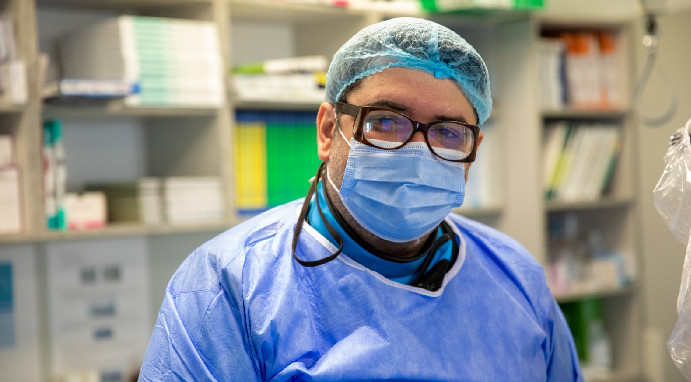
An original enLife News interview, together with Dr. Sebastian Botezatu, Coordinator of the Angiography and Cardiac Catheterism Department at the Dr. Carol Davila Central Military Emergency University Hospital, Bucharest. EnLife News: Hello, Doctor Sebastian Botezatu Can you tell us a bit about your professional career and how you got to this point today? Dr. Sebastian Botezatu: Hello! I am the coordinator of the Angiography and Cardiac Catheterism Department at the Dr. Carol Davila Central Military Emergency University Hospital, Bucharest, since 2016, primary physician in Radiology and Medical Imaging, superspecialization in Interventional Radiology. Photo credit: Central Military Emergency University Hospital Dr. Carol Davila My professional activity consists in performing a wide range of minimally invasive angiographic interventions, focusing in particular on the interventional treatment of cardio-vascular and neuro-vascular diseases. I reached this point in my career through passion, learning through each therapeutic intervention performed and through training courses both in the country and abroad. EnLife News: Mr. Doctor Botezatu, why did you choose a career in radiology at a public hospital and especially a military structure? Do you also have an academic or military background? Dr. Sebastian Botezatu: I followed a military career from the age of 15, graduating in 1999 from the Dimitrie Cantemir National Military College and in 2005 from the Medical-Military Institute of the UMF Carol Davila Bucharest. Having a military professional training, being always guided by the desire for development and innovation in the field in which I work, wanting to always help people, I chose and had the chance to carry out my work in the Military Hospital, thus having the opportunity to apply and develop my knowledge which I accumulated during my medical training in a public hospital. EnLife News: What types of interventions do you do at the Central Military Hospital: Carol Davila”, what is the structure of the department (doctors, specializations) and what are the current and future projects. Dr. Sebastian Botezatu: In the department, together with my fellow cardiologists and interventional radiologists and fellow assistants trained in this field, a wide range of minimally invasive cardiac, neurological, peripheral vascular, oncological, etc. interventions are performed. We perform and want to develop the most innovative therapeutic procedures, at the same level as international centers. At this moment one of the main projects is to expand the interventional treatment of acute cerebrovascular accident. Photo credit: Central Military Emergency University Hospital Dr. Carol Davila EnLife News: Which interventions are priority and what are the current facilities of the department you work with? Cardio, peripheral, neuro-vascular (aneurysms, stroke), biopsies, diagnosis? Dr. Sebastian Botezatu: We perform all the listed interventions with priority in three angiography rooms equipped with complete and state-of-the-art equipment. Personally, I focus on the treatment of neurovascular pathology, namely embolization aneurysms, fistulas, cerebral vascular malformations and the treatment of acute ischemic stroke. Photo credit: Central Military Emergency University Hospital Dr. Carol Davila EnLife News: How do you see the development of Interventional radiology in 2024-2025 or in the next decade? Where do you think technology and medicine are going in this area? Dr. Sebastian Botezatu: The development of interventional radiology has been extensive in recent years worldwide and is constantly expanding, many of the classic surgical techniques being replaced by the minimally invasive angiographic ones, especially in the cardio, neuro-vascular and oncological fields. Romania must keep up and finance new techniques in medicine and the training of staff, something that happens with difficulty and for this reason the centers that carry out such interventions are insufficient, and the specialists are very few compared to Europe. EnLife News: What does the patient need to know in order to benefit from the interventional radiology solutions in your department and what signs should he or she, the family members, the family, society pay attention to? Dr. Sebastian Botezatu: First of all, doctors who take a patient with a certain condition must refer him to us for a specialized diagnosis and treatment. Any patient who has a referral to angiography, to our department, benefits from interventional radiology solutions depending on the pathology. Unfortunately, in our country the addressability to the doctor remains low, patients and their families only have to go to the doctor regularly and on time to prevent or diagnose a certain condition. Fortunately, Interventional Radiology is one of the branches of medicine that actually has curative solutions. I can list some of these successfully treated pathologies, some characterized by high mortality: acute ischemic stroke, aneurysm of any location, vascular malformations, ischemia of any organ or limb, pulmonary thromboembolism, acute or chronic hemorrhages, malignant or benign oncological pathology , uterine fibroid, prostate adenoma, spinal discopathy and many others. Photo credit: Central Military Emergency University Hospital Dr. Carol Davila EnLife News: What situations does your hospital or department face? Do you have enough financial funds from the hospital budget or national health programs for all the interventions and devices you need? What would be the ideal level? Dr. Sebastian Botezatu: In short, and for multiple reasons beyond our control, the funds are totally insufficient. We are one tenth of the ideal level. The most efficient devices available on the market are also very expensive and we can purchase them in tiny percentage compared to the need. EnLife News: In Romania, is there the necessary training, centers, enough doctors to do performance medicine in your specialty? What does the current picture look like? Dr. Sebastian Botezatu: In European countries with a medical system at an optimal level, we have one angiographer in the public system for approximately 25,000 inhabitants. In Bucharest we have one angiographer for at least 100,000 inhabitants, not to mention the rest of the country where the centers can be counted on the fingers. Statistically, we are in last or penultimate place in Europe in thrombectomy treatment of acute stroke, which is the second cause of mortality and the first cause of disability. The current picture looks grim, but a little better because in recent years, the addressability of young doctors to this specialty seems to have increased compared to the last decade. Photo credit: Central Military Emergency University Hospital Dr. Carol Davila EnLife News: What other challenges do you face personally, professionally, and at the system, hospital level? Dr. Sebastian Botezatu: The main challenge is time, the increased number of patients due to previous reasons. Insufficient funding is and will likely remain your constant challenge. EnLife News: A final word and message for patients and perhaps senior fellows and young residents training for this specialty? Dr. Sebastian Botezatu: Pentru colegii tineri și pentru pacienți transmit că radiologia intervențională și cardiologia sunt unele dintre puținele soluții curative în medicină. În ultimii 20 de ani, tratamentul intervențional al Accidentului Vascular acut ischemic și al Infarctului Miocardic Acut a fost probabil cea mai importantă descoperire în medicină, cu foarte multe statistici favorabile. EnLife News: Vă mulțumim respectuos pentru toate informațiile, bunăvoința, timpul și interviul acordat mai sus! Soluții pentru tratamentele anevrismelor folosite in Radiologia Intervențională


18 apr. 2024


Comentarii